
Oral and systemic health
Treating gum disease: what changes beyond the mouth?
Periodontitis keeps company with cardiovascular disease, but company is not causation. Two randomised trials measured what happens to the arteries and to blood pressure after intensive periodontal treatment. What they showed, what they could not show, and how a trial that aimed higher would need to be built.
- Published
- 9 min read
A question with two halves
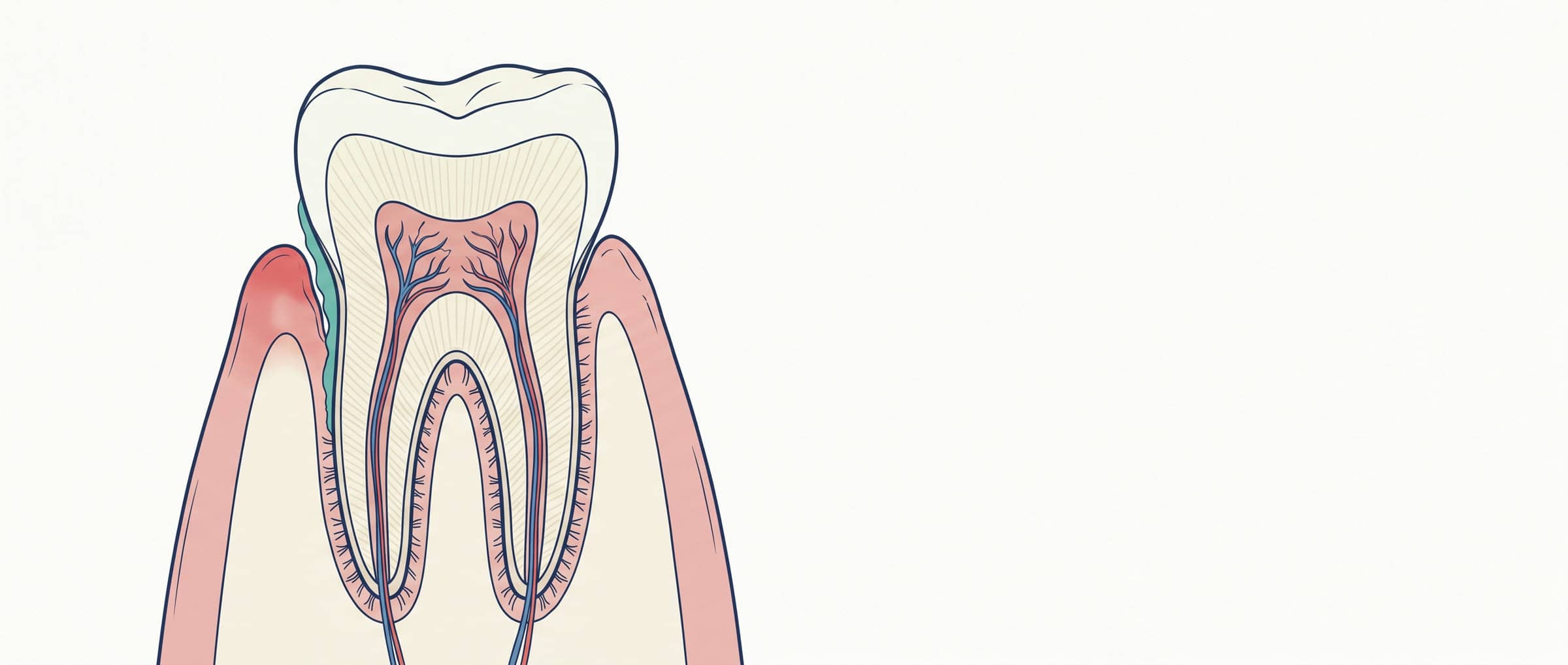
Periodontitis is a chronic bacterial infection of the tissues that hold the teeth, and the immune response to it is what destroys them. In moderate to severe disease the ulcerated surface of the periodontal pockets, added together, approaches the size of a palm, and it sits in continuous contact with a biofilm. Bacteria and their products enter the circulation during chewing and brushing, and the inflamed tissue releases interleukin-6, tumour necrosis factor and other mediators into the blood. C-reactive protein is modestly higher in people with periodontitis than in those without.
That is the first half of the question: a plausible route from a local infection to systemic inflammation. The second half is whether treating the infection changes anything measurable in the vessels. The two halves are often collapsed into one, and the collapse is where most overstatement begins.
Why the associations are hard to read
People with periodontitis have more cardiovascular disease, more hypertension and worse control of it. The association is consistent across cohorts, which is exactly what one would expect whether or not it is causal, because the two conditions share their most important causes. Smoking damages the periodontium and the endothelium. Diabetes does the same. Age, male sex, socioeconomic position, diet and access to care all run in the same direction. Statistical adjustment reduces confounding but cannot remove what was not measured, and periodontal disease is itself a marker of a lifetime of exposures that are hard to capture in a questionnaire.
Observational data therefore generate a hypothesis and cannot settle it. The tools that can move the question are genetic instruments, which separate a predisposition to periodontitis from the lifestyle that accompanies it, and randomised trials of treatment, which separate the effect of removing the infection from everything else. Both have been applied.
Endothelial function after treatment
The first well-controlled intervention study randomised 120 otherwise healthy adults with severe periodontitis to intensive periodontal treatment or to community-based care (Tonetti et al., New England Journal of Medicine 2007). Intensive treatment meant full-mouth subgingival instrumentation under local anaesthesia in a single session, extraction of hopeless teeth and locally delivered antibiotic. Endothelial function was assessed as flow-mediated dilatation of the brachial artery, together with inflammatory and endothelial activation markers, before treatment and at 1, 7, 30, 60 and 180 days.
The first result was a deterioration. Twenty-four hours after treatment, flow-mediated dilatation was lower in the intensively treated group by 1.4 percentage points (95 percent confidence interval 0.5 to 2.3), and C-reactive protein, interleukin-6, soluble E-selectin and von Willebrand factor were all higher. Disrupting a large infected surface in one sitting produces a systemic acute-phase response, and the vessels register it. The curve then crossed. At 60 days flow-mediated dilatation was greater in the treated group by 0.9 percentage points (95 percent CI 0.1 to 1.7), and at 180 days by 2.0 percentage points (95 percent CI 1.2 to 2.8). The degree of vascular improvement correlated with the degree of periodontal improvement. No cardiovascular events occurred in either group, which, in 120 healthy people over six months, is the expected number.
Two features of the design matter for interpretation. The comparator received real care, so the trial estimates the effect of intensity and completeness of treatment rather than of treatment against nothing. And the outcome is a physiological surrogate: flow-mediated dilatation predicts events in populations, but a change of two percentage points in a trial is a change in vascular physiology, not a demonstration that fewer people will have heart attacks.
Blood pressure in people with hypertension
A later study asked the same question in a population where it carried more weight (Czesnikiewicz-Guzik et al., European Heart Journal 2019). It had two parts. A Mendelian randomisation analysis in roughly 750,000 participants used genetic variants associated with periodontitis as instruments and found that genetic liability to periodontitis was associated with higher blood pressure, which is the pattern expected if the relationship is causal rather than a product of shared lifestyle. The second part was a randomised trial: 101 adults with hypertension and moderate or severe periodontitis were assigned to intensive periodontal treatment, meaning subgingival and supragingival scaling with chlorhexidine, or to control treatment consisting of supragingival scaling alone.
The primary outcome was mean 24-hour ambulatory systolic blood pressure at two months, a measurement that avoids clinic effects and is the standard in hypertension trials. Intensive treatment lowered it by 11.1 mm Hg relative to control (95 percent CI 6.5 to 15.8), with improvements in diastolic pressure and flow-mediated dilatation. The size of the blood-pressure fall correlated with the improvement in periodontal status. Circulating interferon-gamma and interleukin-6 fell, as did the proportions of activated and immunosenescent CD8 T cells, the cell populations that animal and human work had already linked to hypertension. Antihypertensive medication was held constant across the trial, which is essential when the outcome is blood pressure.
An 11 mm Hg difference in ambulatory systolic pressure is large; it is of the order produced by adding a drug. It was measured at two months in 101 people at a single centre, and that is the correct frame for it. A smaller earlier trial in 95 people with prehypertension and periodontitis, who were on no antihypertensive medication, reported systolic and diastolic differences of 12.6 and 9.7 mm Hg at six months after intensive treatment (Zhou et al., Journal of Periodontology 2017). A 2025 trial in 40 people with hypertension compared full-mouth with quadrant-wise non-surgical treatment and found that the larger 24-hour rise in high-sensitivity C-reactive protein after full-mouth treatment was associated with a smaller blood-pressure improvement at 90 days (Petrini et al., Journal of Clinical Periodontology 2025). The direction is consistent across these studies; the numbers are small, and the acute inflammatory response is a variable that trial design should respect rather than ignore.
What this evidence does not show
None of these trials measured myocardial infarction, stroke or cardiovascular death, and none was large or long enough to do so. Improvements in endothelial function and reductions in blood pressure are mechanistically coherent and clinically relevant surrogates, and they are still surrogates. A lower 24-hour pressure sustained over years would be expected to reduce events; whether periodontal treatment sustains it over years, in people who also receive ordinary antihypertensive care, has not been tested. Claims that treating gum disease prevents heart attacks are not supported by the physiological trials and should not be made on their basis. A search of the primary literature in 2026 finds no completed randomised trial of periodontal therapy with cardiovascular events as its primary endpoint.
Established
Observational association
Periodontitis is more common in people with cardiovascular disease. Shared causes such as smoking, diabetes and socioeconomic position are hard to remove by adjustment.
Established in small to medium trials
Mechanistic and physiological trials
Randomised treatment studies measure intermediate outcomes: flow-mediated dilatation, 24-hour blood pressure, inflammatory markers, immune cell subsets, over weeks to months.
Not yet available
Cardiovascular outcome trials
Randomised, long follow-up, hard endpoints: myocardial infarction, stroke, cardiovascular death. None has been completed for periodontal therapy.
How an oral-systemic trial should be built
The design questions follow directly from the studies above. Concurrent treatment must be fixed. If antihypertensive drugs can be adjusted during follow-up, any blood-pressure difference is uninterpretable, and if the control group receives better medical care because they are in a trial, the periodontal effect is diluted. Participants on stable medication for a defined period before enrolment, with changes prohibited or prespecified, is the minimum.
The comparator must deliver real periodontal care, as both trials did, because withholding treatment from people with destructive disease is unethical and because the clinically relevant question is whether more complete treatment adds something. The timing of outcome assessment must avoid the acute phase: measurements in the first week after intensive treatment capture the inflammatory response and will make the treatment look harmful. Two to six months is where the existing trials found their signal, and longer follow-up is needed to know whether it persists as periodontal health is maintained or lost.
The endpoint should be chosen for the question. For a physiological question, 24-hour ambulatory systolic pressure is well validated, objective and sensitive to change. For a clinical question, only a trial with events as its primary endpoint will do, and the sample size for that trial can be estimated from the blood-pressure effects already observed. Those are the conversations in which a periodontologist and a cardiovascular trialist need to be in the same room.
This note draws on the research of Professor Marta Czesnikiewicz-Guzik, who led the hypertension trial, with cardiovascular input from Professor Tomasz Guzik. The evidence base is taught in depth in the periodontology programme.
Insights are expert summaries for professionals. They are not medical advice and do not replace the cited sources.